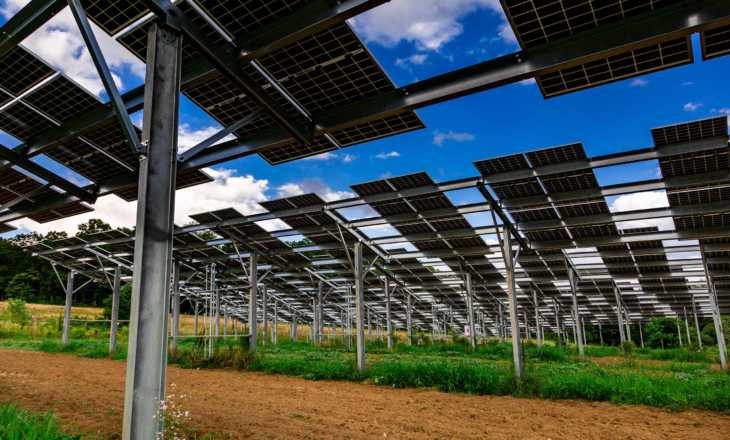
Farmland and solar farms usually compete for the same land. But what if one field could do both? That’s the idea behind agrivoltaics: combining solar panels with crops or grazing on the same plot, so land can grow food and generate energy at once.
As clean energy demand grows, more land is being used for solar energy production. Meanwhile, farmers face drought, rising costs, and a need for new income. Agrivoltaics offers one answer to both. Research shows it can reduce drought stress on crops, lower heat on solar panels, improve microclimates, and give farmers a second revenue stream.
In the following video clips from her E4C Webinar, Dr. Lisa Bosman at Purdue Polytechnic Insitute of Purdue University discusses the basics of agrivoltaic systems, their benefits, and the real-world barriers to wider adoption, from policy gaps to a lack of decision-making tools.
Dr. Bosman shares her own research, including a solar valuation tool, predictive maintenance work, supply and demand forecasting, and an agrivoltaic decision support system that helps farmers weigh the costs and benefits of adding solar to their land. She also discusses policies that can support broader adoption of agrivoltaic systems on farms.
Learn More: Agrivoltaics Harvest the Sun Twice
Challenges and Opportunities in Agrivoltaics
Solar Energy Bluebook: Valuing PV Projects
The Myth of Set It and Forget It
Forecasting Supply and Demand
Decision Support Tools for Farmers
This clip references two papers that Dr. Bosman co-wrote. They are found here:
Bosman, L., Kádár, J., Soto, E. et al. A conceptual study examining solar energy adoption for community resilience. Environ Syst Decis 46, 35 (2026).
Bosman, L.; Kádár, J.; Yonnie, B.; LeGrande, A. How Market Transformation Policies Can Support Agrivoltaic Adoption. Sustainability 2024, 16, 11172.
How Market Transformation Policies Can Support Agrivoltaic Adoption
Presenter
 Dr. Lisa Bosman, Phd in Industrial Engineering, is an Associate Professor in the Purdue Polytechnic Institute at Purdue University in West Lafayette, Indiana (USA). Her doctoral dissertation examined solar energy performance modeling, providing a foundation for her ongoing work at the intersection of renewable energy, sustainability, and engineering education.
Dr. Bosman has served as Principal Investigator for an NSF-funded Research Experiences for Undergraduates (REU) Site focused on applied energy and entrepreneurial-minded research. Her work explores how innovative energy technologies, including agrivoltaics, can support sustainable and resilient communities.
Moderator
 Dr. Vivek Garimella is an Assistant Professor in the Department of Mechanical Engineering at Rice University in Houston, Texas (USA), where he serves as the Principal Investigator of the Multiscale Thermal Solutions Laboratory (MTSL). He received his PhD in Mechanical Engineering from the University of Illinois Urbana-Champaign (UIUC), and in 2025 he was a visiting researcher at the International Institute for Carbon-Neutral Energy Research (I2CNER) at Kyushu University in Fukuoka, Japan. His teaching and research are in both the fundamentals and applications of thermodynamics, fluid mechanics, heat transfer, and manufacturing for energy. At UIUC, he participated in the SCAPES agrivoltaics project supported by the USDA.
Photo by AgriSolar Clearinghouse / CC BY 2.0