Suggested Articles

Investment Trends: Social Ventures Follow the Money Trail in Emerging...
Investors have turned their attention and opened their checkbooks to social startups working in developing countries and underserved communities. Hardworking founders have begun to raise as much as...
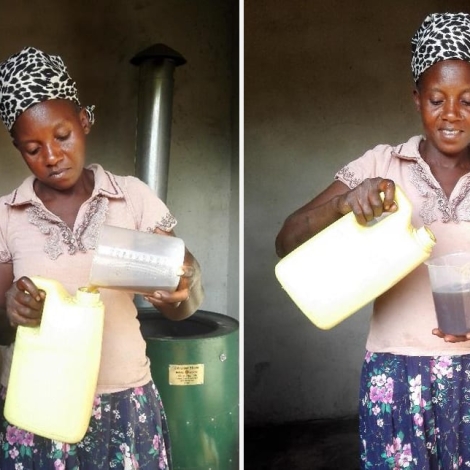
I’m curious about the emissions from the process – that’s a large smokestack, do you have any scrubbers in there?
Hi Anna, Thanks for your question. The energy to run the process comes via a rocket stove manufactured by InStove (www.instove.org) in Cottage Grove, Oregon. This wood fired stove is incredibly efficient. The stack gas produced doesn’t actually need any scrubbing. The InStove rocket stove reduces particulate by 90% versus an open fire and produces no visible smoke.
There have been many plastic->oil “solutions” before, but each of them has had at least one major problem slowing adoption – as I understand it, and applied to what I read above for your system, the typical issues are:
a) a lot of energy required to run the process – for example the system from blest.co.jp used more electricity to run than the diesel produced could have generated (in locations where most electricity came from diesel). Yours is in a wood stove, but the energy balance isn’t mentioned, how much wood does it take to make a liter of diesel-substitute?
b) good separation required e.g. working on only one kind of plastic. This can add significant cost, especially for soft plastics which are rarely marked. You don’t mention how pure the input stream has to be?
c) seriously toxic waste resulting from the unconverted plastic, all the halogens in the plastic end up in the waste – unless the separation mentioned above is done. Is there a waste issue in your process ?
d) further refining steps – some of the processes produce the equivalent of crude that has to then go in a “normal” refiner, making them only suitable for large scale use – sounds like this isn’t an issue for you. .
I’d be interested in how your solution stacks up against each of these.
What are the time and temperature involved? Is there any chance that a solar concentrator stove could be used instead of a wood burning stove?
Hi Mitra, Great questions! Several of them are addressed in a paper we recently published in the Journal of Environmental Progress and Sustainable Energy (DOI:10.1002/ep.13086). As our published work demonstrates, the energy balance is positive, even for wood fuel, and the total CO2 emissions are lower than petroleum derived fuels on a total life cycle basis. As for the feed stream, our process only uses HDPE, LDPE and Poly Propylene as inputs. Other plastics, as you correctly point out have potentially toxic emissions. The good news is that these plastic are easy to identify. Suitable plastics float in water, where as unsuitable plastics sink. That’s how we train users to tell the difference. Since we only use select plastics, no further refining is necessary. Our process isn’t a magic bullet, of course, but we believe that is a sustainable solution for developing regions. Thanks for your interest!
Hi Newt, the temperature required is about 450C. The time of course depends on the heating time and batch size, but for our process the process runs for about 3 hours and begins producing within about 20 minutes. As for solar concentration, I don’t know of a small scale unit that gets up to 450C, but if there is one it could certainly be used! Thanks for your questions!
Interesting did you see anyone do this plastic separation in your field tests ? From the one project I saw in southern India plastic separation was expensive and significantly added to the cost. For the flotation method it sounds like they need a shredder which adds the questions of can you shred plastic bags, and is the energy cost of the shredding included, and you list LDPE, HDPE and Poly Propylene but I thought styrofoam (not listed) also floats ?
Notably missing from the paper is any kind of costing, at a reasonable estimate of production cost of the stove, and the shredder, and the cost of labor for separation & production what kind of cost do you think is achievable per liter of fuel ?
Thanks for making the paper open-access, closed access papers being largely irrelevant to the field of international development ! For those who don’t speak DOI, the paper is at https://onlinelibrary.wiley.com/doi/full/10.1002/ep.13086
Hi Mitra, For our field trials, the users were trained to separate the plastic. In Uganda, there is a thriving economy for people working in the trash dumps picking and separating trash of all types. So far, the issue of separation hasn’t caused us a problem, but we are working with NGOs to select those who are using the process, so we are able to do the training up front. Styrofoam, as you mention is a bit of a bugger. Polystyrene does not float but styrofoam does. Although it certainly makes acceptable fuel, the concern is cyclic aromatics in the product, which are of course often toxic. We advise operators not to use it, but it is a source of risk. We haven’t published the economics in full because we are still evaluating, but a preliminary case study can be found here (DOI:10.1002/ep.13086). I can share with you that the pilot studies are looking positive from the economic standpoint, but are some regulatory hurdles still to cross before this can be fully commercialized. So far our work is classified as research but broad scale implementation requires regulatory approval. We hope to be publishing a full economic assessment after our planned expanded field trials this summer. Thank you again for your questions and interest in this work.
Hi Jeff, This is amazing. Is there a way we in India can get access to this pilot program and move it real Plastic Fuel pumps for villages.. I would be very keen to get it launched.Secondly is the a way to use Solar heat for ‘slowly pyrolizes plastic waste using heat instead of heat produced by burning wood or other biomass’. While collecting plastics 1 Kg ( is there specific type of plastic ) is there any restrictions. What is the possibility to make it on a larger size than the size of equipment shown.
Hi rajanbh24tech, Absolutely! In fact we pilot tested this process in Tamil Nadu a few years ago. We used the fuel for irrigation pumps. The plastics that we use are polyethylene (HDPE and LDPE) and polypropylene. Although polystyrene makes good fuel, there are some potential toxicity concerns with the off gas. For that reason, we stay away from it. Concentrated solar might work, if you can achieve the proper temperature. I’m not familiar with a solar stove that can get hot enough, but in principle it could work. Scale up is also possible, but I haven’t run the economics calculations, so I can’t yet say if it would be profitable. I would be happy to provide more information to you.
I am very interested to try this processor in my country as we also have a huge plastic waste problem. Please advise and help me on how to obtain this processor and receive training on how to operate and maintain this processor unit.
Thank you.
Mr. Oveai Morea