Suggested Articles
Data Scientists Pinpoint Sources of Lead Contamination to Solve the...
The Swiss mechanical engineer Lt. Eduard Rubin invented the copper-jacketed rifle bullet in 1882, right about the time that lead pipes had come under scrutiny for poisoning drinking...
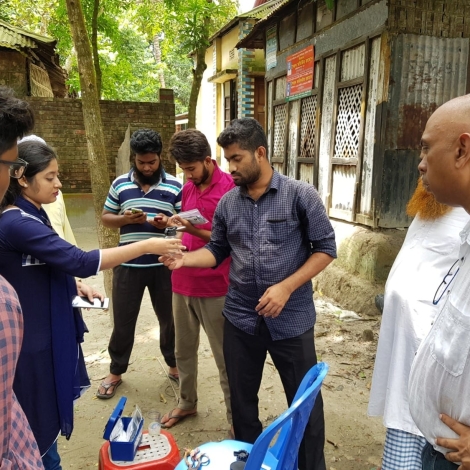
Please be cautious relying on field test kits for arsenic. A lot of research has cast doubt on their accuracy/reliability. For example, see our recent paper, “Evaluation of arsenic field test kits as a learning exercise for engineering students in global water and sanitation class” https://ojs.library.queensu.ca/index.php/ijsle/article/view/12528
Reply to Jpkearns excellent comment. It is true that field kits can be unreliable. From the many projects that I have been doing in arsenic mitigation in the field the way I circumvent this issue is as follow: If when testing the well water there is no stain I accept the result that the well water is arsenic free. When the result is within the borderline of the MCL I recheck it in the laboratory with more precise techniques. This brings me to the bigger issue at hand that since so many years have passed by from the late nineties when the arsenic crisis came to the focus we have not yet developed an accurate cost effective field level arsenic in water detection devise. I am once again imploring the international scientists and engineers to embark in this much needed endeavour. I am offering to host any scientists and engineers to work with me in this. I will host you in Bangladesh and provide you with all logistic support. If you want to contact me my email is: nadim.khandaker@northsouth.edu.