Apply now: 2026 UN Call for Innovations

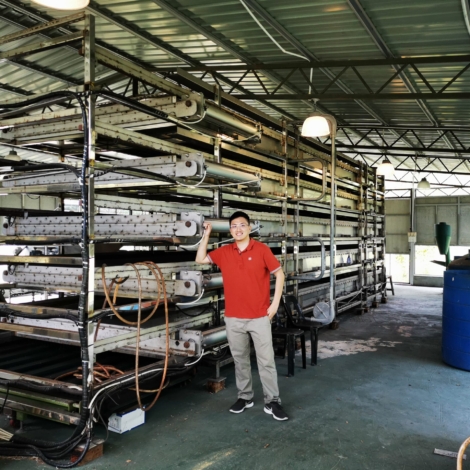
Willie Ng. Photo courtesy of Global Cerah
Willie Ng leads Global Cerah, a sustainable agriculture startup based in Malaysia that he says is not widely understood. Earlier this year, he had an opportunity to explain the venture and pitch his ideas for it to a global audience. Global Cerah was one of ten startups featured in the UN Science, Technology and Innovation Forum in 2025.
The STI Forum invites early-stage innovators to share scalable ideas that address challenges in low-resource settings. Selected solutions are featured for an international audience of policymakers, researchers, and technical experts.
Global Cerah is a circular economy enterprise that converts agricultural waste into animal feed, organic fertilizer, and biomass. Mr. Ng’s work reduces emissions and creates jobs for more than 600 people. The startup has treated roughly 50,000 metric tons of organic waste from 6000 farmers and converted most of it into fertilizer and feed. The system reduces farmers’ production costs by 40 percent, saving them about (USD) $2500 per month.
Mr. Ngs’s experience in New York set some changes in motion. The STI Forum connected Mr. Ng with peers, potential partners and global supporters who helped him expand his venture’s reach beyond Malaysia. Global Cerah now plans to scale its waste treatment capacity to 1 million tons within three years, which is a leap for a company that began operating in 2021.
Now Mr. Ng has plans for regional hubs across Asia and expansion through knowledge sharing across borders. In conversation with Engineering for Change, he offers a view of what progress can look like after the STI Forum.
E4C: Would you recommend the experience of joining the STI Forum?
WN: Of course I really encourage others to join the showcase, especially those who would like to share their innovative solutions from around the world. It’s a very good opportunity for us to let the public, potential partners, and even other stakeholders understand our solutions. It can create a positive impact. It’s the best platform to showcase to stakeholders around the world.
E4C: Since participating, have you been able to leverage connections you made?
WN: The best thing was to connect with fellow peers and potential partners. We actually had the opportunity to build networks and create potential collaboration opportunities. I think that is something that is really hard to find in other platforms or events. That’s the number one thing.
The second thing has been the chance to exchange knowledge with other participants. Even though we may be from different fields or different backgrounds, it was an opportunity for me to understand how others work on innovations. Especially learning not just about their good solutions, but how they commercialize them to serve a wider audience with a sustainable business model. There’s a lot of knowledge and experience that you do not see often at other events.x
E4C: Have you had a notable success since the showcase?
WN: After I joined the forum and showcased my solution, I had followup calls with organizations and some [potential] partners, so they understand about my solution and understand about my products.
We are doing an integrated, organic waste treatment system. Not everyone understands the solution, and not many people know what we are doing. So, the forum allows us to showcase our solution and our products to those who are interested in bringing our solution to others in other regions. We are based in Malaysia, Southeast Asia, but now I have had the chance to connect with potential customers, people buying our products, and potential collaborators based in Europe and also based in Africa. So I think this has been a very good opportunity for us.
E4C: What is next for Global Cerah?
WN: We want to build a regional circular economy using our solution, bringing our solution to other countries in Southeast Asia and also other regions by licensing the technology to others. We can have hubs in different regions connected with each other through our system. Using IoT [Internet of Things] applications, we can have the data and build a regional circular economy. Then we can encourage people to, instead of disposing of their waste, to circulate their waste to convert it into valuable resources for the agriculture industry.
E4C: You have said your goal is to increase waste treatment capacity to 1 million tons over the next three years. Is that on track?
WN: Yes. So, because of this 1 million target, we are connecting with different hubs that want to organize in the region. We expanded from Malaysia to Indonesia and the Philippines. These are the countries where we have expanded and shared our solutions. In the next three years, we want to expand to other Southeast Asia countries, especially Thailand, Vietnam and Cambodia. And then we also have targeted others country beyond the region, like Korea, Japan and China.