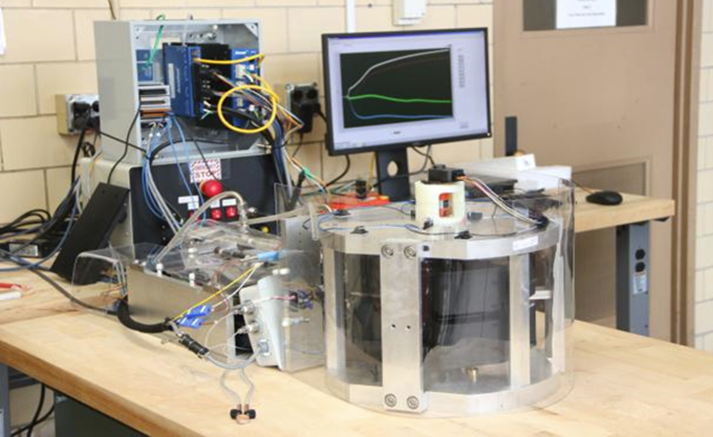
Dr. Radhika Barua at VCU and team built this prototyp of a solid-state magnetic heat pump that could lead to a more sustainable replacement for traditional HVAC technology. Photo courtesy of Dr. Radhika Barua
What are the bottlenecks to deploying magnetocaloric cooling? How can we achieve larger temperature changes? Is additive manufacturing viable for scaling a future product? These are your questions about solid-state heating and cooling with magnetocaloric materials.
Dr. Radhika Barua at Virginia Commonwealth University presented her team’s research on the technology, positioning it as an alternative to traditional vapor-compression systems that exacerbate climate change. Her talk outlined how these materials heat or cool under changing magnetic fields. If deployed, future products may be suitable for off-grid and resource-constrained communities.
This written Q&A gathers her responses to questions raised during the session. She answered verbally after the presentation, then she emailed responses to questions she didn’t have time to answer live. This Q&A offers a clearer view of the opportunities and remaining challenges in bringing magnetocaloric cooling from the lab to real-world use.
Q: What are some of the bottlenecks that you foresee coming up as we try and scale up and take the place of traditional vapor compression?
RB: So from from just the system perspective itself, I think there are a lot of things that we still need to fix to make a magnetic heat pump more affordable and accessible. For sure, material is just one aspect of the story. The regenerator, which makes the material, is what I spoke about. What I did not speak about today are the magnet assemblies that magnetize and demagnetize the regenerator. The magnet assembly is a whole different story by itself.
A couple of things to note here. The higher the magnetic field, the higher the magnetic caloric response. So, if you can give a high magnetic field, that’s great. I don’t know if you’ve noticed in many of the slides I showed that the magnetic applied field was two Tesla, at least. And two Tesla is huge. So, I think we will have to solve the permanent magnet problem and solve it fast. You know, design the magnetic circuit just right so we can get the response that we want with as low a magnetic field as possible.
Now, there are ways to do that. The magnetic circuit needs to be designed just right. That will bring the cost down. And I think once that happens, and once we’ve solved the magnet problem, the device will also become more and more compact, and that’s something which is definitely of interest to the commercial market. You want something small, not a huge refrigerator sitting in the corner of your house.
So magnet, regenerator, the materials that go into the regenerator, the supply chain issue (which is the case with everything, of course). If you can address these, I think that will be a win.
Q: The changes in temperature across each stage that you were showing seem to be relatively small. At least in the graphs that you’re showing, there is a small Delta T. So how do we get a sufficiently large Delta T?Â
[Note that Delta T (Δ) is a measurement of the temperature change between two points. In HVAC systems, Delta T is the temperature difference between the return air and the supply air coming from the air conditioner or furnace. A low Delta T could mean the system isn’t cooling or heating enough.]
RB: Compositional grading is the key. You change the composition slightly. You can tune the transition temperature, and you can tune the adiabatic temperature change that you see. Ideally, along the length of the regenerator bed, you would make it with one composition of lanthanum iron silicide, replace it gradually with another and another and another, and that would make a compositionally graded bed. That’s the idea behind making this graded regenerator. If you make it graded, and it’s a continuous interface, you can expand the temperature change, and that is what we’re driving towards.
We’re trying to 3D print it. The first stage would be to make it, and then once you hit the composition in the right space, tweak it just that much so that we can grade it across the length.
If you could make it via 3d printing, something that would graded along the length, with slightly different compositions, we could achieve it. And that’s the dream, that’s the ultimate goal we’re working towards.
Q: Are there advances in additive manufacturing that need to happen to increase the throughput to get the type of scale that we would need to have? Will 3D printing be suitable to make enough of these fast enough to replace traditional technology?
RB: That’s actually a really good question. Additive manufacturing is great for prototyping. When you want to make something that is custom, one sample at a time. But what is best for mass production? That’s the answer that I think you’re looking for. It would be laser powder bed fusion. The way it works is you have a powder bed and you have a laser that comes in and it prints apart, layer by layer. And there’s a huge bed, so you can print many samples together. Powder bed fusion is the way to go. So, the next challenge up ahead is scalability, definitely.
Q: Would the research consider the design of new composite materials with higher Delta T?
RB: Yes. Modern magnetocaloric research increasingly focuses on designing composite materials to achieve higher adiabatic temperature change and a broader working temperature range. By combining phases with slightly different Curie temperatures, integrating high-conductivity metal or polymer matrices, or creating functionally graded architectures, composites can enhance the magnetocaloric response, improve heat transfer, and reduce hysteresis losses. This multi-phase design approach enables sharper or broadened transitions, more efficient heat exchange, and greater mechanical durability, ultimately delivering improved performance in practical magnetic refrigeration systems compared to single-phase materials.
See clips from Dr. Barua’s presentation here and on the seminar page.