Suggested Articles

Towards Net Zero Buildings in Kenya
Towards Net Zero Buildings in Kenya BuildX Studio is dedicated to working towards net zero carbon buildings in Kenya by measuring and lowering the carbon footprint of building...
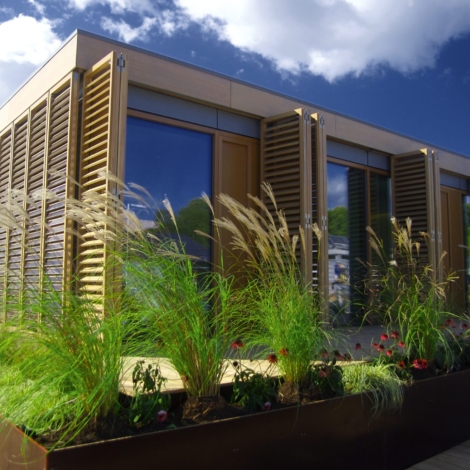
The building sector needs to decarbonize. This blueprint shows how to do it. Pictured is a passively cooled building. Photo: Jeff Kubina (CC BY-SA 2.0)
Towards Net Zero Buildings in Kenya BuildX Studio is dedicated to working towards net zero carbon buildings in Kenya by measuring and lowering the carbon footprint of building...
I live in a rural area of Northern California. Our local electricity provider (PG&E) does not service a majority of the properties around us. It costs us $30k per power pole to get electricity service to our properties, and you can imagine how many poles there are per mile of line. We rely on solar power for lighting, generators for recharging batteries when the sun is not able to keep up (winter), wood for heat, and natural gas for cooking and hot water. The properties that do have electrical service experience prolonged blackouts around once a month year round, so we are grateful for our wood heat and gas appliances.
My wife works at a grid tie and offgrid solar installation company so we are very familiar with the limitations of off grid battery systems. You absolutely cannot run a fridge, heat pump, water heater and cook stove off of the amount of batteries and panels that a normal household can afford. Most off grid homes locally cannot run an electric coffee pot or toaster oven without degrading their battery life or kicking the generator on. I feel that these types of policies are developed by well intentioned engineers in urban environments that do not understand the impact these types of rules will have on people in rural areas. Banning gas appliances will absolutely degrade the lives of middle class poor, and indigenous people in rural areas that already pay more for energy than people in urban areas. There absolutely needs to be exceptions for these rules based on population density, economics, availability of electrical service etc..
According to the AB 1504 California Forest Ecosystem and Harvested Wood Product Carbon Inventory: 2019 Reporting Period each acre of mixed woodland forest in California sequester 2.5 metric tons of carbon per year. Most of our forested parcels locally are 40 acres in size (and larger) and support a single family. At 40 acres they can sequester up to 100 tons of carbon per year. A gallon of gasoline produces around 20 lbs of Co2e per gallon, so each 40 acre parcel can sequester 22 average cars worth of carbon per year. Please don’t punish rural people that are already paying taxes to maintain our forests as carbon sinks, but receive no benefit for the it. We are already seeing parcels get logged as families are forced off their properties for economic reasons.