NEWS December 5, 2025

Planting Disabled Futures in Virtual Realities

How can VR help us develop non-extractive relationships with plants, prompting us to connect deeper with the world even in pain, in climate emergency, and in our ongoing pandemic states? Plants help us develop new virtual realities, and in turn, Planting Disabled Futures can help us re-engage in our non-virtual realities.

What is the role of plants in developing virtual realities? Engineers might know about biomimicry, the work of seeing ways nature has already solved the problems we are facing. In the physical world, the applications might seem obvious: Velcro (hook-and-loops) technology was inspired by the cocklebur seeds that stuck to the dog of Swiss engineer George de Mestral. The water-repellant Ā qualities of lotus leaves and other natural surfaces inspired a novel method of mimicking those surface patterns using lasers (Fusion Bionic).

To understand how plants inspire virtual realities, we turn to the Planting Disabled Futures project led by disability studies scholar and performance artist, Dr. Petra Kuppers. Planting Disabled Futures (or cheekily, PDF) is a multi-modal VR experience developed to share energy, liveliness, ongoingness, disabled joy and experiences of pain.

You put on a headset and are transported into a tree landscape with pink canopies, cascading waterfalls, lavender mushrooms, floating fireflies, and delightful little isopod critters creeping along the rocky bases. As you fly through the world, you come across bubbling teal portals. Upon entering a portal, it transports you into a different installation co-created by a global cast of disabled performance artists, poets, and their plant friends.

‘Planting Disabled Futures’ Flythroughs

Planting Disabled Futures fosters non-destructive, respectful interactions with plants. We are not seeking to extract, but rather to honor and to learn from our plant elders. Elders such as the tree we grew up climbing on or sitting next to, the lilac bush that gives us hope of spring after a long Michigan winter, or even the friend with a green thumb who helps us care for that beautiful vining plant on the windowsill. Nature is so wise, and disability culture gives us the space to honor her.

In VR, we sink ourselves into the roots of a tree and look up in a 360-degree panorama as the sounds of Petra’s humming vibrate around us. We lay on our backs on the lawn of a London park with disabled choreographer Elisabeth Motley, playing with almost childlike wonder in the blades of grass. We entangle ourselves in the branches of a curry plant with disabled interdisciplinary artist and bioinformatician Ashwini Bhasi.

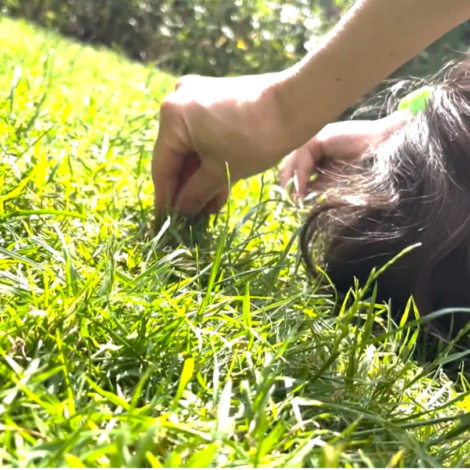
This close-up screen capture from a portal video shows bright sunlight on a field of green grass. Elisabeth Motley lays on her back, reaching her arms above her head to grasp blades of grass in her fingers, eyes closed in the sun. Photo: Dr. Petra KuppersĀ 

Disabled and plant perspectives reconfigure the role of VR from an isolated entertainment vehicle to one that explores essential questions about difference, relationships, and connection.

Most VR experiences cater to abled people, which adds the unintended layer of abled escapism when disabled people take part. HowĀ  can VR allow us to celebrate difference, rather than engage in hyper-mobile fantasies of overcoming disability and dissociating from life? How can VR help us develop non-extractive relationships with plants, prompting us to connect deeper with the world even in pain, in climate emergency, and in our ongoing pandemic states? Plants help us develop new virtual realities, and in turn, Planting Disabled Futures can help us re-engage in our non-virtual realities.

Image Description: A tree landscape, with pink canopies, waterfalls, blue/purple trunks and roots, with light blue portals and lavender mushrooms, inviting a swooping visit.

This image from the VR experience depicts a tree landscape with pink canopies, waterfalls, trunks and roots with light blue portals and lavender mushrooms that invite a swooping visit. Image courtesy of the authors.

Planting Disabled Futures explores virtual reality (VR) technologies to ask questions about access, community, environmental poetics, and futures of queer/disabled play. One does not play in the PDF world alone – you’re invited to settle in with a trained access doula, hold a plushy critter like the ones you’ll see in the VR world, and become entangled with the ways we as disabled people honor and engage with plant eldersĀ .

Discover more about Planting Disabled Futures at the project website. We are seeking further opportunities to demo the project and would love to coordinate virtual or in-person engagements with interested organizations. We are planning to release the APK on the Meta Horizon store in 2026, compatible with Quest headsets. We are also delighted to share the APK as it currently stands with any who would like to trial it. Please contact Petra (petra@umich.edu) or Laura (lrmurphy@umich.edu) for more information.


About the Authors

Dr. Petra Kuppers is a disability culture activist, writer, dance video maker and community performance artist. She teaches at the University of Michigan as the Anita Gonzalez Collegiate Professor of Performance Studies and Disability Culture. Learn more about her at petrakuppers.com.

Dr. Laura R. Murphy is a consultant and lecturer in inclusive design and engineering. She consults with teams in academia, non-profits, and industry, and teaches graduate courses on equity-centered engineering and project-based design at the University of Michigan. Learn more about Dr. Murphy at her LinkedIn page.

Leave a Reply

Join a global community of changemakers.

Become A Member