Agriculture
January 11, 2024
Caminos de Agua Ceramic filters
Read SolutionImplemented by
Caminos de Agua
Updated on January 11, 2024
·Created on September 26, 2019
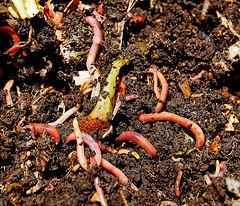
Vermicomposting is the process by which worms are used to convert organic materials into compost, which can be used as fertilizer.
Vermicomposting is the process by which worms are used to convert organic materials into compost, which may be used as fertilizer. Vermicomposting can be done in bins, heaps, or windrows.
Regarding the price it will depend on local costs of worms and bins.
Target SDGs
SDG 6: Clean Water and Sanitation
Target Users (Target Impact Group)
Household, Community, Small and Medium-sized Enterprises, NGOs
Distributors / Implementing Organizations
Unknown
Competitive Landscape
Direct competitors include Rotary Drum Composting and NADEP Composting.
Regions
Worldwide
Manufacturing/Building Method
This product can be produced using locally available materials in the form of a bin or a windrow.
Intellectural Property Type
Open-source
User Provision Model
Users put the bin or windrow together themselves using their preferred design.
Distributions to Date Status
Unknown
Input requirement (volume and frequency)
68 kg, additional food scraps with paper/dirt layer can be added weekly
Additives
Worms, shredded paper
Production capacity (kg output per kg input)
87 kg output per 168 kg input
Production duration
~60-90 days
Percentage of nutrient recovery
1.7% nitrogen, 1.3% phosphorous
Complementary treatment needed
None
Design Specifications
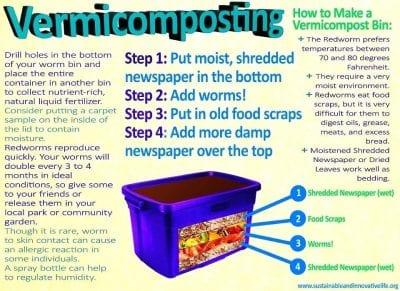
For a bin, the user should take two plastic bins. The shorter, wider bin (made of rubber or plastic) approximately 15 inches deep, 25 inches wide and 5 inches high would be used as the bottom to collect liquid. The top bin may be roughly an 18 gallon tub about 15 inches deep, 20 inches wide and 15 inches tall. This bin needs a lid, with a 1-inch hole drileld about two inches from the top on either side, and with four 1/8-inch holes near the bottom corners of the bin. Each hole should be covered with vinyl screening. Three inches of shredded paper will be placed in the bottom of the bin mixed with soil and water. Worms should be fed with food scraps once a week, and new paper. Red wrigglers can be used. Worm species may vary, but Lumbricus rubellus (red worm) and Eisenia foetida are thermo-tolerant, European night crawlers (Dendrabaena veneta or Eisenia hortensis) are produced commercially and have been used successfully in most climates, and the African night crawler (Eudrilus eugeniae) is a tropical worm species, though it does not do well in colder temperatures.
Windrows may also be used for composting. Cow manure is piled about 90 cm across and 90 cm high, seeded with worms, and fresh manure is added to the end of the row as the worms move forward. Rows should be covered to keep them shaded and cool and moistened when needed.
For both methods, compost is collected at the opposite area to the worms (they can be fed on one side to shift them over for the bin method).
Product Schematics
Technical Support
There is no technical support provided and users are expected to maintain the product on their own.
Replacement Components
None
Lifecycle
Unknown
Manufacturer Specified Performance Parameters
N/A
Vetted Performance Status
Testing evaluated temperature and pH, different plant species' growth in vermicompost, nitrogen and phosphorous availability, and the C-N ratio.
Safety
Implementers must taken appropriate precautions when working with organic waste, particularly cattle manure, and ensure complete decomposition.
Complementary Technical Systems
None
Academic Research and References
Ramnarain, Y.A., et al., 2019, Vermicomposting of different organic materials using the epigeic earthworm Eisenia foetida. International Journal of Recycling of Organic Waste in Agriculture 8: 23-36.
Metzger, J.D., Bachman, G.R., 2008, Growth of bedding plants in commercial potting substrate amended with vermicompost. Bioresource Technology 99: 3155-3161.
Kumar, V., Singh, K.P., 2001, Enriching vermicompost by nitrogen fixing and phosphate solubilizing bacteria. Bioresource Technology 76: 173-175.
Ndegwa, P.M., Thompson, S.A., 2000, Effects of C-to-N ratio on vermicomposting of biosolids. Bioresource Technology 75: 7-12.
Ndegwa, P.M., Thompson, S.A., 2001, Integrating composting and vermicomposting in the treatment and bioconversion of biosolids. Bioresource Technology 76: 107-112.
Ghosh, M., et al., 1999, Transformation of phosphorus during vermicomposting. Bioresource Technology 69: 149-154.
Compliance with regulations
Unknown
Evaluation methods
Testing evaluated temperature and pH, different plant species’ growth in vermicompost, nitrogen and phosphorous availability, and the C-N ratio.
Other Information
On-farm composting methods - Vermicomposting
Agriculture
January 11, 2024
Implemented by
Caminos de Agua
Agriculture
January 17, 2024
Implemented by
Aquagenx
Agriculture
December 26, 2023
Implemented by
Bobs Harries Engineering Ltd (BHEL)
Agriculture
December 29, 2023
Implemented by
Vestergaard
Agriculture
January 18, 2024
Implemented by
Barry Lloyd, University of Surrey
Agriculture
December 27, 2023
Implemented by
SOVEMA

Agriculture
August 14, 2024
Implemented by
SoaPen
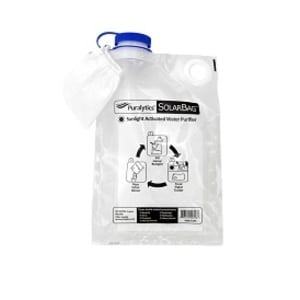
Agriculture
January 17, 2024
Implemented by
Puralytics
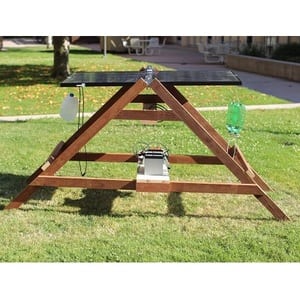
Agriculture
January 17, 2024
Implemented by
Roseicollis Technologies
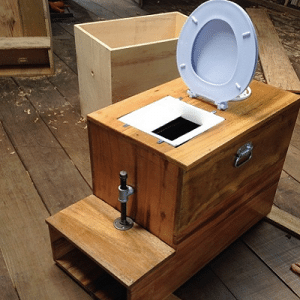
Agriculture
January 2, 2024
Implemented by
Toilets for People
Have thoughts on how we can improve?
Give Us Feedback