Wow, glad the special issue found a new home! As a new academic, I was shocked to find out that discrimination by national origin could even be allowed. As a graduate student in a western university, do you have any suggestions for what we can do? Our advisors/supervisors are typically the ones who select the journals and co-authors – I want to do what I can to push the field to be more progressive in publishing, but that relies heavily on those more established in the field.
Hi Anna,
Thanks for your comment! Ethical research really shouldn’t allow discrimination in this way. In this case, the profit incentives of the journal appear to take priority over ethical publishing practices. I would suggest that even as a early career researcher, it is possible to voice your concerns about the inclusion/exclusion of co-authors and the journals that your work is published in. Be clear on what your university’s ethics board says about authorship (Elsevier authorship guidance, the Council of Science Editors (CSE), and the International Committee of Medical Journal Editors (ICMJE) all agree on the same basic principles) and highlight this when you are discussing authorship with supervisors. The Elsevier CRediT statement is a useful way to gauge who did what when drawing up a paper’s author list. When it comes to selecting journals, there is less clarity. Check Beall’s List for predatory journals, share information like this blog with researchers if they are considering a journal that appears to have operated in ethically dubious ways in the past, and remind researchers that where they publish affects how the research community sees them. Working in ethical ways benefits all of us, and increases trust in our work, within the research community and outside of it. For a quick and easy overview of what ethical research practices look like, The Singapore Statement on Research Integrity is a good starting point, but your university almost certainly has a code of research conduct that covers many of the same points. By referring to this documentation when you are discussing potential issues with more senior researchers, you demonstrate that you care about doing things the right way, which hopefully opens up a conversation about what that looks like and how all of us can contribute to improving our community.
Thanks,
Becky
Many of you learned about the distribution challenge from my colleague and Essmart’s co-founder, Jackie Stenson. If you haven’t watched her E4C webinar, please do so. It is...
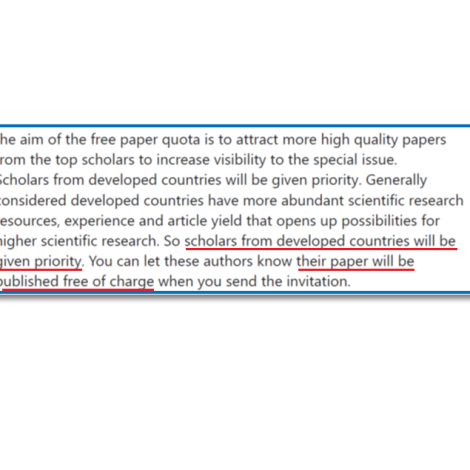

Wow, glad the special issue found a new home! As a new academic, I was shocked to find out that discrimination by national origin could even be allowed. As a graduate student in a western university, do you have any suggestions for what we can do? Our advisors/supervisors are typically the ones who select the journals and co-authors – I want to do what I can to push the field to be more progressive in publishing, but that relies heavily on those more established in the field.
Hi Anna,
Thanks for your comment! Ethical research really shouldn’t allow discrimination in this way. In this case, the profit incentives of the journal appear to take priority over ethical publishing practices. I would suggest that even as a early career researcher, it is possible to voice your concerns about the inclusion/exclusion of co-authors and the journals that your work is published in. Be clear on what your university’s ethics board says about authorship (Elsevier authorship guidance, the Council of Science Editors (CSE), and the International Committee of Medical Journal Editors (ICMJE) all agree on the same basic principles) and highlight this when you are discussing authorship with supervisors. The Elsevier CRediT statement is a useful way to gauge who did what when drawing up a paper’s author list. When it comes to selecting journals, there is less clarity. Check Beall’s List for predatory journals, share information like this blog with researchers if they are considering a journal that appears to have operated in ethically dubious ways in the past, and remind researchers that where they publish affects how the research community sees them. Working in ethical ways benefits all of us, and increases trust in our work, within the research community and outside of it. For a quick and easy overview of what ethical research practices look like, The Singapore Statement on Research Integrity is a good starting point, but your university almost certainly has a code of research conduct that covers many of the same points. By referring to this documentation when you are discussing potential issues with more senior researchers, you demonstrate that you care about doing things the right way, which hopefully opens up a conversation about what that looks like and how all of us can contribute to improving our community.
Thanks,
Becky